The Plain-English Guide to Sleep Apnea & Sleep Studies
Snoring loudly, waking up gasping for air, or dragging through your days exhausted? Here is what is actually happening in your airway, what tests and numbers mean, and how you can sleep peacefully again.
Adults worldwide affected
Remain undiagnosed today
Non-invasive testing at home
What Actually Happens During Sleep Apnea?
No complex medical jargon. Here is how it works inside your throat and why your body reacts the way it does.
Your Airway as a Soft Drinking Straw
When you fall asleep, all the muscles in your body relax, including the muscles in your throat and tongue. In most people, the airway stays open enough for air to glide freely into the lungs.
With Obstructive Sleep Apnea (OSA), those relaxed tissues collapse like a soft plastic drinking straw being sucked on too hard. The airway pinches completely or partially shut. Your chest moves to breathe, but zero air gets through.
The Silent Adrenaline Alarm
Before the airway shuts completely, the narrow space makes tissues vibrate loudly — that is snoring. When it closes completely, total silence falls for 10 to 60 seconds until you suddenly gasp, snort, or choke awake.
When oxygen drops, your brain panics and sends a jolt of adrenaline to force you awake just enough to reopen your throat. You might not remember waking up, but this can happen 30 to 90 times an hour, completely destroying restorative deep sleep.
The 3 Distinct Types of Sleep Apnea
Obstructive Sleep Apnea (OSA)
Physical blockage: throat tissues, uvula, or tongue collapse into the airway. Accounts for ~85–90% of all cases.
Central Sleep Apnea (CSA)
Signal breakdown: the brainstem forgets to tell the chest muscles to breathe. Not a physical blockage. Common with heart conditions.
Complex / Mixed Sleep Apnea
A combination of both physical blockage and neurological signal pauses, often revealed during CPAP titration.
Watch It in Motion: 3D Animations & Doctor Explanations
Sometimes seeing what happens inside the throat makes everything click. Watch these medically accurate animations and clinical walkthroughs.
How Sleep Apnea Blocks Your Airway (3D Animation)
A 3D medical animation by LifeNest demonstrating how the airway collapses, soft tissues obstruct airflow, and how breathing pauses occur during sleep.
Key Takeaways from This Video:
- See the tongue base and soft palate relax and physically block the trachea.
- Watch the difference between regular unobstructed airflow and total airway blockage.
- Understand how breathing stops and why oxygen levels drop during an apnea episode.
Note: These videos are curated for patient education and do not replace personalized consultation with a licensed sleep physician.
Common Symptoms Checklist: Do You Have Sleep Apnea?
Check the symptoms you or your bed partner have noticed. Many people live with these for years thinking they are just "getting older" or "stressed."
Loud, Persistent Snoring
Snoring so loud it can be heard through closed bedroom doors or drives your partner to another room.
Waking Up Gasping or Choking
Sudden jolts awake feeling like you cannot catch your breath, or witnessed pauses by a partner.
Exhausted All Day (2 PM Crash)
Feeling like a zombie despite being in bed for 7–8 hours; struggling to stay awake while driving or at work.
Waking with Dry Mouth or Sore Throat
Parched throat every morning caused by heavy mouth breathing throughout the night.
Dull Morning Headaches
Headaches upon waking that fade after an hour, caused by nightly carbon dioxide retention.
Waking to Urinate 2+ Times
Heart strain from breathing pauses produces the ANP hormone, signaling kidneys to dump fluid at night.
Brain Fog, Memory & Mood Shifts
Trouble focusing, short temper, and feeling easily overwhelmed due to lack of deep restorative sleep.
What Is a Sleep Study Really Like?
Many people delay testing because they fear it will be painful or claustrophobic. In reality, modern sleep studies are 100% painless and non-invasive.
Home Sleep Test (HST / Type 3)
Done in your own bed, your own pillows
A lightweight palm-sized device mailed to your door. You wear a comfortable chest band, a small finger sensor for oxygen, and soft nasal oxygen prongs.
What it feels like: Just like sleeping at home. No hospital stay, no needles. Drop it back in the mail the next day.
In-Lab Polysomnography (PSG / Type 1)
The comprehensive gold-standard hospital or clinic study
An overnight stay in a quiet, private hotel-style clinical suite. Sensors gently stick to your scalp, face, chest, and legs to capture brain waves (EEG), heart rhythm, and limb movements.
What it feels like: Gentle adhesive stickers. You can read, use your phone, and sleep. A quick-disconnect cord allows easy bathroom trips.
CPAP Titration / Split-Night Study
Finding your exact personalized pressure
During this study, you wear a comfortable CPAP mask while a specialist remotely adjusts the air pressure until your snoring and breathing pauses vanish.
What it feels like: Peaceful, uninterrupted breathing. Most patients wake up amazed at how deeply they slept.
How to Read Your Sleep Study Report
When you get your results, you will see a bunch of acronyms. Here is what they actually mean for your health.
The AHI Scale: Apnea-Hypopnea Index
This is the most critical number: how many times per hour your breathing paused or reduced for at least 10 seconds.
Fewer than 5 pauses per hour. Healthy baseline. No sleep apnea diagnosis.
5 to 14 pauses/hr. Often managed with positional therapy, lifestyle changes, or oral appliances.
15 to 29 pauses/hr. Airway closes every 2–4 minutes. CPAP or medical intervention strongly advised.
30+ pauses/hr (some reach 60–100+). Your body is in a state of emergency all night. Immediate therapy needed.
Oxygen Saturation (SpO₂ Nadir)
Normal blood oxygen during sleep is 95%–100%. Drops below 90% indicate hypoxemia. When oxygen drops into the 80s or 70s, your heart and brain are starved of vital oxygen.
Sleep Architecture (Deep & REM Sleep)
Restorative sleep requires Stage 3 Deep Sleep (~15–20%) and REM Dream Sleep (~20–25%). Frequent apneas rip you out of these restorative phases into light Stage 1 sleep.
Real Treatments: Giving You Your Life Back
Sleep apnea is very treatable. Over 90% of patients who stick with therapy report life-changing surges in energy, mental clarity, and mood.
CPAP Therapy (Continuous Positive Airway Pressure)
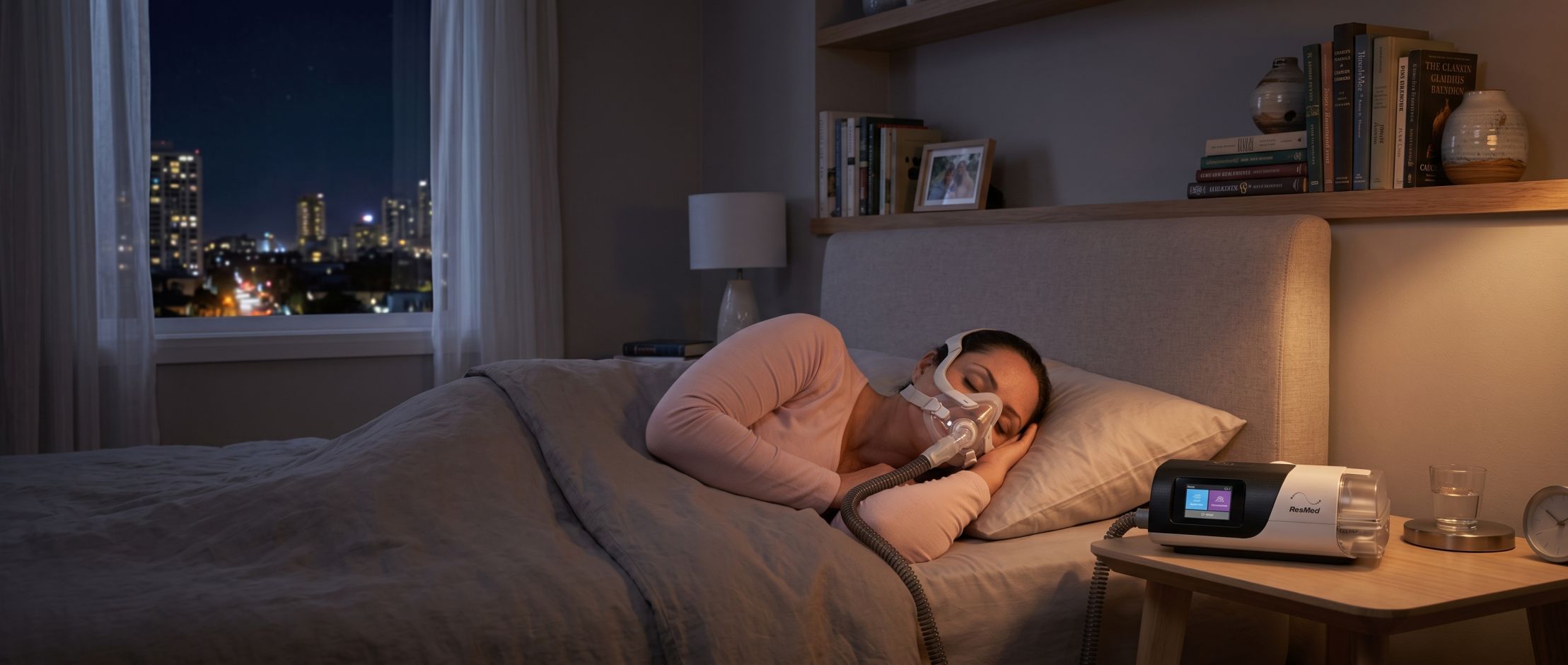
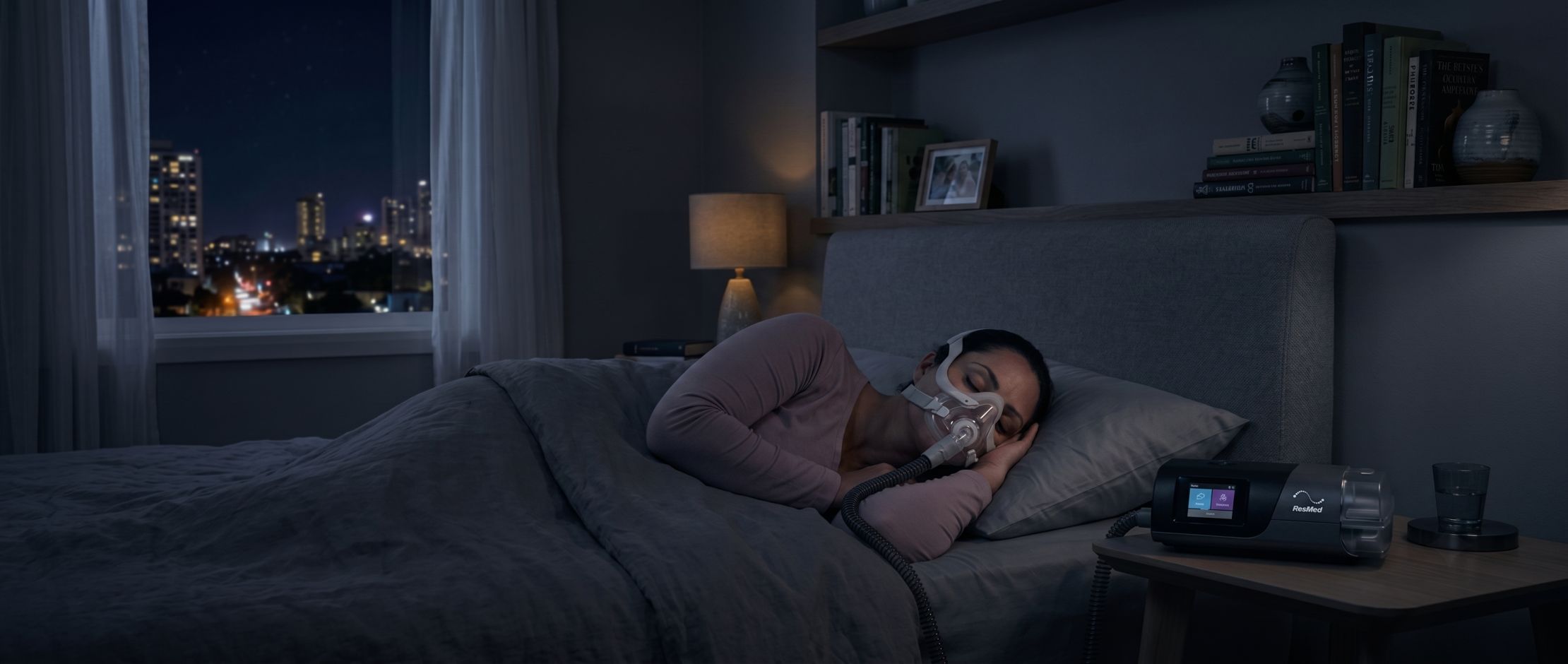
A compact bedside unit delivers a gentle, continuous stream of warm, humidified air through a comfortable mask, acting as an invisible air splint that prevents throat collapse.
Honest Truth About Getting Used to CPAP
Will it feel a little weird for the first 5 to 10 nights? Yes, absolutely. You are learning to sleep with a mask on your face. But modern CPAP units are whisper-quiet (~26 dB, quieter than a whisper), feature heated humidifiers so your nose does not dry out, and auto-ramp up pressure only after you fall asleep.
BiPAP (Bilevel Therapy)
Provides two pressures: higher pressure when you inhale, and drops lower when you exhale. Ideal for patients who need higher pressures or have central apnea.
Custom Oral Dental Appliances (MAD)
A custom mouthguard made by a qualified sleep dentist. It gently shifts your lower jaw forward, pulling the tongue away from the throat. Great for mild-to-moderate OSA.
Positional Sleep Aids
Gravity pulls your tongue backward most when sleeping on your back (supine). Positional pillows and vibrating belts keep you sleeping comfortably on your side.
Lifestyle, Nutrition & ENT Health
Weight management, reducing evening alcohol (which paralyzes throat muscles), clearing sinus passages, and regular daytime exercise significantly decrease AHI numbers.
Frequently Asked Questions (Real Human Answers)
Answers to the questions real patients ask their doctors every day.
Ready to wake up feeling truly rested?
Whether you want to order a convenient Home Sleep Test or talk to a sleep doctor, your journey to quiet nights and energized mornings starts here.